


Chapter-2
Solution
Expressing concentration of solution
Molarity:-
It depends on temperature. It is defined no. Of moles of solute dissolved in 1L of solution (M).
Molarity = moles of solution / Volume of solution in L
Molality:-
It is defined as ratio of no. of moles of solute dissolved in 1kg of solvent and it express that (M)
Molality = moles of solute / Weight of solvent in kg
Does not depend on temperature.
Out at molarity and molality is best because it does not depend upon volume.
Mole fraction:-
Mole fraction of a component it is defined as.
= no. of moles of the component / Total no. of moles of all component
XA = nA / nA+nB
XB = nB / nA+nB
XA + XB = 1
Part per million (PPM):-
When solute is present in trace quantities (fine particles) is expressed in PPM
Ppm is defined as:
PPM = no.of parts of the component /
total no. of part of all the component present in solution * 10^6
Mass percentage(w/w)%
It is defined as mass of the component in solutionby total mass of the solution.
(w/w)% = mass of component in solution / total mass of the solution * 100
volume percentage (v/v)%
it is defined as:
(v/v) = volume of the component / total volume of solution * 100
henry law:
This law is applied for solubility for gas in liquid
According to this law
the mass of the gas dissolved in a given volume of liquid at constant temperature is directly proportional to the pressure of the gas present in equilibrium with the liquid. mathematically we can write:
m ∝ p m = kH * p
where, kH is known Henry constant
and it depend on the nature of the gas
Also we can write as follow:-
the solubility of a gas in a liquid is it directly proportional pressure of the gas in equilibrium with the at the temperature so we can write solubility in term of mole fraction of the gas hence Henry law can also written as:
XA = PA XA = KH * PA
Another form of henry law also used
PA ∝ XA
PA = KH * XA
Partial pressure of a gas in a vapour phase directly proportional to mole fraction of that gas in a solution.
values of henry constant for some gases in water
temp./k KH
O2 = 293 = 34.86 O2 = 303 = 46.82
PA = KH * XA
KH ∝ 1/XA
KH ∝ 1/solubility
Greater is the value of KH lower is the solubility of gas at the same partial pressure. The values of KH increase with increasing in temperature it means solubility decrease with increase in temperature at the same pressure.
Application of Henry law:-
*During the production of soft drinks CO2 must be sealed at high pressure to increase its solubility.
*At high attitude partial pressure of oxygen is less than at the ground level as the result there is low concentrate of oxygen in the blood. That is why they feel weak an able to think properly at decrease called anoxia.
*In the deep sea driving scuba divers must cope with high concentrated of dissolved gases while breathing air at high pressure under water increase pressure increase solubility of gas in blood. when drivers comes towards surface pressure decrease this release the dissolved as gas and causes formation of bubbles of nitrogen in the blood.
This blocks the capillaries and create a medical condition called bends.
which is very painful and dangerous to life to avoid this condition tank filled with helium 11.7% nitrogen 56.2% Oxygen 32.1%.
Raoult's law:-
In a solution the vapour pressure of component at a given temperature is equal to the mole fraction of that component in the solution multiplied by vapour pressure that component in pure state.
PA = P'XA ...........................(1)
PB = p'XB ............................(2)
total pressure PT = PA+PB
PT = P'AXA+P'BXB
we know,
XA+XB = 1
XA = 1-XB
PT = P'A(1-XB) + p'BXB
PT = P'A - P'AXB + P'BXB
PT = p'A - XB(P'B - P'B)
Types of solution on the basic of raoult's law:-
On the basis of raoultes law there are two types of solution
1. ideal solution
An ideal solution is that solution in which each component of solution obey raoult's law at every temperature and pressure.
for a solution to be ideal following condition must be satisfied
1. There will be no change in volume on mixing the two component.
∆Vmix = 0
2. There will be no change in enthalpy (that is no heat is absorb or release) when the two component are mixing.
∆ Hmix = 0
Practically no solution is ideal but few example given below
benzene + tolune
normal haptane + n - hexane
2. non ideal solution
A solution which do not obey raoult's law at all condition of temperature and pressure for a such solution
∆Hmix ≠ 0 & ∆Vmix ≠ 0
There are two types of non ideal solution
1. showing positive deviation
2. showing negative deviation
phase diagram for ideal solution:
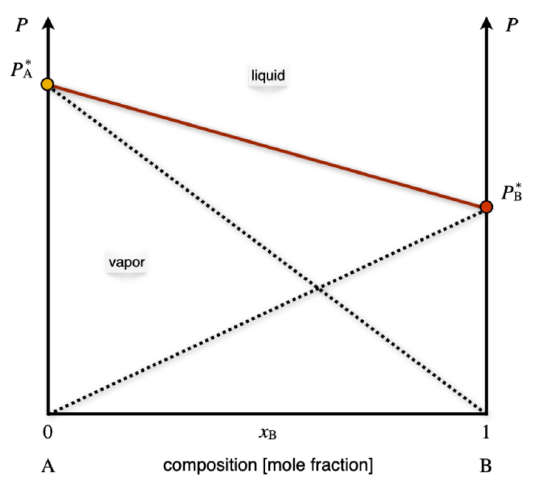
phase diagram for positive deviation:
phase diagram for negative deviation:

phase diagram for positive and negative deviation:

Examples of positive deviation showing ideal solution
mixture of ethanol and acetone
examples of negative deviation showing ideal solution
mixture of acetone and chloroform
In ideal solution interaction between A-A and B-B is equal to interaction between A-B
In non ideal solution showing positive deviationA-B interaction weaker than A-A and B-B
And postive deviation from ideal solution A-A and B-B are weaker then A-B interaction.
In case of postive deviation showing non - ideal solution molecules of pure ethanol are bonding on addition acetone H-bonds are disturbs.
Due to beginning of interaction the solution shows positive deviation from raoult's law.
In case of negative deviation (mixture of CHCl3 and acetone) chloroform is able form H- bonds with acetone mole so vapour pressure decrease resulting in negative deviation.
mixture of phenol and aniline example of negative deviation.
Azeotropes:
These are the binary mixture the same composition in liquid and vapour phase and while a constant temperature. it is not possible separate the component by fractional distillation.
There are two types of Azeotropes:-
1. minimum boiling Azeotropes
2. maximum boiling Azeotropes
Colligative properties:
All these properties which depends upon the numbers of solute particles irrespective of their nature are called colligative properties.
Relative lowering of vapour pressure:
Vapour pressure of solvent in solution is less than that of the pure solvent from raoults law we know that vapour pressure of solution is given by:
P1 = X1P'1
The reduction in vapour of solvent (∆P1) will be given by:
∆P1 = P'1-P1
= P'1-P'1X1
= P'1(1-X1)
know in at.....XA+XB=1 OR X1+X2=1
XA=1-XB X2=1-X1
TP1=P'1X2
dividing by p'1 ∆P1/P'1=p'1X2/P'1
∆P1/P'1=X2
P'1-P1/P'1=X2
P'1-P1/P'1=n2/n1+n2
X2=n2/n1+n2
n1 and n2 are the no.of moles of solvent for dilute solution n1>>n2
p'1-p1/p'1=n2/n1
p'1-p1/p'1=w2*m1/m2*w1
Elevation in boiling point:
Boiling point of solution is always higher that at the boiling point at pure solvent.
elevation in boiling point also depends upon numbers of solute molecules

let Tb be the boiling point of pure solvent and Tb be the boiling point of solution the increase in the boiling point ∆Tb=Tb-T'b
∆Tb=Tb-T'b
is known as elevation in boiling point.
∆Tb is directly proportional to molality or molal concentration
∆Tb ∝ m
∆Tb= kbm
here kb is called boiling point is elevation condtant molal elevation constant.
Also,known as ebullioscopic constant.
Unit of kb = kkg/mol
m = moles of solute/mass
Depression of freezing point
The lowering in vapour pressure causes a lowering in freezing point as compare to that of pure solvent.

Let T'f be the freezing point of pure solvent and Tf will be freezing point when non- volatile solute is added to solvent So, the freezing point decrease.
∆Tf ∝ m
∆Tf = kfm
Here kf is called molal depression constant or cryoscopic constant. or depression freezing point.
osmosis
This process takes place from lower concentration to heigher concentration.
"In this process their is floe of solvent molecules through a SPM.
Differentiate between diffusion and osmosis
Osmosis
- SPM is required.
- In this process their only flow of solvent molecules.
- It takes place from lower concentartion to higher concentration.
- It can be stoped or reversed by applying pressure on the solution with higher concentartion.
Diffussion
- No need of SPM.
- solvent as well as solvent moves directly into each other.
- It takes place from higher to lower concentration.
- It cannot be stoped or reverse.
osmotic pressure the minimum access pressure that has to be applied on the solution to prevent the entry of solvent into the solution through a SPM is called osmotic pressure
Expression for osmotic pressure
π ∝ C
π ∝ T
π ∝ CT
π = CRT
Where π is the osmotic pressure
π = n/v*RT
Where,
n = moles of solute
V = volume of solution in L
R = gas constant
T = temperature in (K)
πV = w2RT/πV
M2 = w2RT/πV
Isotonic solution
such solution having same osmotic pressure at the same temperature are called isotonic solution.
Hypotonic solution
solution which have lower osmotic pressure is called hypotonic with respect to more concentrated solution.
Hypertonic solution
The more concentrated solution is called hypertonic with respect to dilute solution. Explain of some phenomena on the basis of osmosis
raw mangoes shrink into pickles when place in concentrated common salt solution due to out flow water through SPM due to osmosis people talking a lot swelling of their tissue dissolved called edema this this is due to retention of water from the tissue.
Reverse osmosis
The direction of osmosis can be reverse if a larger pressure then he osmotic pressure is applied to a solution side due to this your solvent follows out of the solution through SPM this process is called reverse osmosis.
abnormal molar mass and one have factor
i = normal molar mass / abnormal molar mass
i = no.of particle after dissociation or association / no. of particles
before association or dissociation
i = observed colligative property / calculated colligative property.



